
See below our calendar of church services for the next few weeks:
Whilst you are here, please also subscribe to the site so you never miss an announcement or news about services, events or other important information. Just enter your email in the box below to receive notifications directly to your inbox.
For a detailed monthly Greek Orthodox Liturgical calendar please follow this LINK
With much thanks to the Greek Archdiocese of America for some of the service detail contained below.
Πάσχα/Easter 2026
As always there is a packed service schedule this Πάσχα with the holiest of weeks commencing Saturday 4th April and culminating Sunday 12th.
We will be publicising the whole April services calendar soon, but are giving parishioners as much notice as possible about Easter services so you can put the dates into your diaries.
You can also pick up the Easter schedule leaflet now from the church during service hours.


March 2026
In March we are fully into the Lenten season as we prepare for Pascha. There are five Sunday Divine Liturgy Services, plus we celebrate the announcement by Archangel Gabriel to Virgin Mary that she has been chosen to give birth to Our Lord Jesus Christ.
There is also a service each Friday evening in March for Heretismi and the recital of the full Akathist Hymn on 27th March. The first Heretismi service is actually this Friday 27th February at 19.00.
| Day | Date | Start | End | Details | Scripture Readings | |
|---|---|---|---|---|---|---|
| Friday | 27th Feb | 19.00 | 21.00 | First Salutations (Heretesmi) | Isaiah 3:1-14, Genesis 2:20-3:20, Proverbs 3:19-34 | |
| Sunday | 1st | 9.30 | 12.45 | Sunday of Orthodoxy | Luke 24:12-35, Hebrews 11:24-26,32-40, John 1:43-51 | |
| Friday | 6th | 19.00 | 21.00 | Second Salutations (Heretesmi) | Isaiah 7:1-14, Genesis 5:32-6:8, Proverbs 6:20-7:1 | |
| Sunday | 8th | 9.30 | 12.45 | Sunday of St Gregory Palamas | Luke 24:36-53, Hebrews 1:10-14;2:1-3, Mark 2:1-12 | |
| Friday | 13th | 19.00 | 21.00 | Third Salutations (Heretesmi) | Isaiah 13:2-13, Genesis 8:4-21, Proverbs 10:31-11:12 | |
| Sunday | 15th | 9.30 | 12.45 | Sunday of the Holy Cross | John 20:1-10, Hebrews 4:14-16;5:1-6, Mark 8:34-38; 9:1 | |
| Wednesday | 18th | 8.00 | 9.00 | Liturgy of the Presanctified Gifts | ||
| Friday | 20th | 8.00 | 9.00 | Liturgy of the Presanctified Gifts | ||
| Friday | 20th | 18.30 | 19.30 | Fourth Salutations (Heretesmi) | Isaiah 29:13-23, Genesis 12:1-7, Proverbs 14:15-26 | |
| Sunday | 22nd | 9.30 | 12.45 | Sunday of St John Climacus | John 20:11-18, Hebrews 6:13-20, Mark 9:17-31 | |
| Wednesday | 25th | 9.30 | 11.30 | Annunciation of the Theotokos | Luke 1:39-49, 56, Hebrews 2:11-18, Luke 1:24-38 | |
| Friday | 27th | 8.00 | 9.00 | Liturgy of the Presanctified Gifts | ||
| Friday | 27th | 18.00 | 20.30 | Akathist Hymn Service (5th Friday of Lent) | Isaiah 45:11-17, Genesis 22:1-18, Proverbs 17:17-18:5 | |
| Sunday | 29th | 9.30 | 12.45 | Sunday of St Mary of Egypt | John 20:19-31, Hebrews 9:11-14, Mark 10:32-45 |
Sunday of Orthodoxy

For more than one hundred years the Church of Christ was troubled by the persecution of the Iconoclasts of evil belief, beginning in the reign of Leo the Isaurian (717-741) and ending in the reign of Theophilus (829-842).
After Theophilus’s death, his widow the Empress Theodora (celebrated Feb. 11), together with the Patriarch Methodius (June 14), established Orthodoxy anew. This ever-memorable Queen venerated the icon of the Mother of God in the presence of the Patriarch Methodius and the other confessors and righteous men, and openly cried out these holy words: “If anyone does not offer relative worship to the holy icons, not adoring them as though they were gods, but venerating them out of love as images of the archetype, let him be anathema.”
Then with common prayer and fasting during the whole first week of the Forty-day Fast, she asked God’s forgiveness for her husband. After this, on the first Sunday of the Fast, she and her son, Michael the Emperor, made a procession with all the clergy and people and restored the holy icons, and again adorned the Church of Christ with them.
This is the holy deed that all we the Orthodox commemorate today, and we call this radiant and venerable day the Sunday of Orthodoxy, that is, the triumph of true doctrine over heresy.
Sunday of St. Gregory Palamas

This divine Father, who was from Asia Minor, was from childhood reared in the royal court of Constantinople, where he was instructed in both religious and secular wisdom. Later, while still a youth, he left the imperial court and struggled in asceticism on Mount Athos, and in the Skete at Beroea. He spent some time in Thessalonica being treated for an illness that came from his harsh manner of life.
He was present in Constantinople at the Council that was convened in 1341 against Barlaam of Calabria, and at the Council of 1347 against Acindynus, who was of like mind with Barlaam; Barlaam and Acindynus claimed that the grace of God is created. At both these Councils, the Saint contended courageously for the true dogmas of the Church of Christ, teaching in particular that divine grace is not created, but is the uncreated energies of God which are poured forth throughout creation: otherwise it would be impossible, if grace were created, for man to have genuine communion with the uncreated God.
In 1347 he was appointed Metropolitan of Thessalonica. He tended his flock in an apostolic manner for some twelve years, and wrote many books and treatises on the most exalted doctrines of our Faith; and having lived for a total of sixty-three years, he reposed in the Lord in 1359.
His holy relics are kept in the Cathedral of Thessalonica. A full service was composed for his feast day by the Patriarch Philotheus in 1368, when it was established that his feast be celebrated on this day. Since works without right faith avail nothing, we set Orthodoxy of faith as the foundation of all that we accomplish during the Fast, by celebrating the Triumph of Orthodoxy the Sunday before, and the great defender of the teachings of the holy Fathers today.
Sunday of the Holy Cross
With the help of God, we have almost reached the middle of the course of the Fast, where our strength has been worn down through abstinence, and the full difficulty of the labour set before us becomes apparent. Therefore our holy Mother, the Church of Christ, now brings to our help the all-holy Cross, the joy of the world, the strength of the faithful, the staff of the just, and the hope of sinners, so that by venerating it reverently, we might receive strength and grace to complete the divine struggle of the Fast.

Sunday of St. John Climacus
St John Climacus is celebrated today because his book, The Ladder of Divine Ascent, is a sure guide to the ascetic life, written by a great man of prayer experienced in all forms of the monastic polity; it teaches the seeker after salvation how to lay a sound foundation for his struggles, how to detect and war against each of the passions, how to avoid the snares laid by the demons, and how to rise from the rudimental virtues to the heights of Godlike love and humility. It is held in such high esteem that it is universally read in its entirety in monasteries during the Great Fast.

Annunciation of the Theotokos
Six months after John the Forerunner’s conception, the Archangel Gabriel was sent by God to Nazareth, a town of Galilee, unto Mary the Virgin, who had come forth from the Temple a mature maiden.
According to the tradition handed down by the Fathers, she had been betrothed to Joseph four months. On coming to Joseph’s house, the Archangel declared: “Rejoice, thou Full of Grace, the Lord is with thee: blessed art thou among women.”
After some consideration, and turmoil of soul, and fear because of this greeting, the Virgin, when she had finally obtained full assurance concerning God’s unsearchable condescension and the ineffable dispensation that was to take place through her, and believing that all things are possible to the Most High, answered in humility: “Behold the handmaid of the Lord; be it unto me according to thy word.” And at this, the Holy Spirit came upon her, and the power of the Most High overshadowed her all-blameless womb, and the Son and Word of God, Who existed before the ages, was conceived past speech and understanding, and became flesh in her immaculate body (Luke 1:26-38).

Bearing in her womb the Uncontainable One, the blessed Virgin went with haste from Nazareth to the hill country of Judea, where Zacharias had his dwelling; for she desired to find Elizabeth her kinswoman and rejoice together with her, because, as she had learned from the Archangel, Elizabeth had conceived in her old age.
Furthermore, she wished to tell her of the great things that the Mighty One had been well-pleased to bring to pass in her, and she greeted Elizabeth and drew nigh to her. When Elizabeth heard Mary’s greeting, she felt her six-month-old babe, Saint John the Baptist, prophesied of the dawning of the spiritual Sun. Immediately, the aged Elizabeth was filled with the Holy Spirit and recognised her as the Mother of her Lord, and with a great voice blessed her and the Fruit that she held within herself.
The Virgin also, moved by a supernatural rejoicing in the spirit, glorified her God and Savior, saying: “My soul doth magnify the Lord, and my spirit hath rejoiced in God my Saviour,” and the rest, as the divine Luke hath recorded (1:39-55).
Today marks the crowning of our salvation and the revelation of the mystery before all ages. For the Son of God becomes the son of the Virgin, and Gabriel proclaims the grace. Wherefore, we also cry out with him, “Hail, O full of grace, the Lord is with you.”
Sunday of St. Mary of Egypt
The memory of this Saint is celebrated on April 1, where her life is recorded. Since the end of the holy Forty Days is drawing nigh, it has been appointed for this day also, so that if we think it hard to practice a little abstinence forty days, we might be roused by the heroism of her who fasted in the wilderness forty-seven years; and also that the great loving-kindness of God, and His readiness to receive the repentant, might be demonstrated in very deed.

February 2026
February sees the start of Great Lent, a time of fasting and contemplation as we prepare for Tο Πάσχα. Sunday services are shown below and a full calendar will be published soon.
| Day | Date | Start | End | Details | Scripture Readings |
|---|---|---|---|---|---|
| Sunday | 1st | 9.30 | 12.45 | Divine Liturgy – Sunday of the Publican and Pharisee: Triodion Begins Today | Matthew 28:16-20, Romans 8:28-39, Luke 18:10-14 |
| Monday | 2nd | 9.30 | 11.45 | Service of the Presentation of Jesus at the Temple | Luke 2.25-32, Hebrews 7.7-17, Luke 2.22-40 |
| Sunday | 8th | 9.30 | 12.45 | Divine Liturgy – Sunday of the Prodigal Son | Mark 16:1-8, I Corinthians 6:12-20, Luke 15:11-32 |
| Tuesday | 10th | 9.30 | 11.30 | Service of Haralambos the Holy Martyr | Luke 21:12-19, II Timothy 2:1-10, John 15:17-27; 16:1-2 |
| Friday | 13th | 18.00 | 19.00 | Vespers of Psychosavvato (Meatfare Friday) | II John 1:1-13, Mark 15:20,22,25,33-41 |
| Saturday | 14th | 9.30 | 11.00 | Saturday of Souls | I Thessalonians 4:13-17, Luke 21:8-9,25-27,33-36 |
| Sunday | 15th | 9.30 | 12.45 | Divine Liturgy – Judgement Sunday (Meatfare Sunday) | Mark 16:9-20, I Corinthians 8:8-13;9:1-2, Matthew 25:31-46 |
| Sunday | 22nd | 9.30 | 12.45 | Divine Liturgy – Forgiveness Sunday | Luke 24:1-12, Romans 13:11-14;14:1-4, Matthew 6:14-21 |
| Friday | 27th | 18.30 | 19.45 | Salutations to Mother of God (1st Friday of Lent) | Isaiah 3:1-14, Genesis 2:20-3:20, Proverbs 3:19-34 |
Sunday of the Publican and Pharisee

The Pharisees were an ancient and outstanding sect among the Jews known for their diligent observance of the outward matters of the Law. Although, according to the word of our Lord, they “did all their works to be seen of men” (Matt. 23:5), and were hypocrites (ibid. 23: 13, 14, 15, etc.), because of the apparent holiness of their lives they were thought by all to be righteous, and separate from others, which is what the name Pharisee means. On the other hand, Publicans, collectors of the royal taxes, committed many injustices and extortions for filthy lucre’s sake, and all held them to be sinners and unjust. It was therefore according to common opinion that the Lord Jesus in His parable signified a virtuous person by a Pharisee, and a sinner by a Publican, to teach His disciples the harm of pride and the profit of humble-mindedness.
Since the chief weapon for virtue is humility, and the greatest hindrance to it is pride, the divine Fathers have set these three weeks before the Forty-day Fast as a preparation for the spiritual struggles of virtue. This present week they have called Harbinger, since it declares that the Fast is approaching; and they set humility as the foundation for all our spiritual labors by appointing that the parable of the Publican and the Pharisee be read today, even before the Fast begins, to teach, through the vaunting of the Pharisee, that the foul smoke of self-esteem and the stench of boasting drives away the grace of the Spirit, strips man of all his virtue, and casts him into the pits of Hades; and, through the repentance and contrite prayer of the Publican, that humility confers upon the sinner forgiveness of all his wicked deeds and raises him up to the greatest heights.
All foods are allowed the week that follows this Sunday.
Sunday of the Prodigal Son

Through the parable of today’s Gospel, our Saviour has set forth three things for us: the condition of the sinner, the rule of repentance, and the greatness of God’s compassion. The divine Fathers have put this reading the week after the parable of the Publican and Pharisee so that, seeing in the person of the Prodigal Son our own wretched condition — inasmuch as we are sunken in sin, far from God and His Mysteries — we might at last come to our senses and make haste to return to Him by repentance during these holy days of the Fast.
Furthermore, those who have wrought many great iniquities, and have persisted in them for a long time, oftentimes fall into despair, thinking that there can no longer be any forgiveness for them; and so being without hope, they fall every day into the same and even worse iniquities. Therefore, the divine Fathers, that they might root out the passion of despair from the hearts of such people, and rouse them to the deeds of virtue, have set the present parable at the forecourts of the Fast, to show them the surpassing goodness of God’s compassion, and to teach them that there is no sin — no matter how great it may be — that can overcome at any time His love for man.
Meatfare Sunday

The foregoing two parables — especially that of the Prodigal Son — have presented to us God’s extreme goodness and love for man. But lest certain persons, putting their confidence in this alone, live carelessly, squandering upon sin the time given them to work out their salvation, and death suddenly snatch them away, the most divine Fathers have appointed this day’s feast commemorating Christ’s impartial Second Coming, through which we bring to mind that God is not only the Friend of man, but also the most righteous Judge, Who recompenses to each according to his deeds.
It is the aim of the holy Fathers, through bringing to mind that fearful day, to rouse us from the slumber of carelessness unto the work of virtue, and to move us to love and compassion for our brethren. Besides this, even as on the coming Sunday of Cheese-fare we commemorate Adam’s exile from the Paradise of delight — which exile is the beginning of life as we know it now — it is clear that today’s is reckoned the last of all feasts, because on the last day of judgment, truly, everything of this world will come to an end.
All foods, except meat and meat products, are allowed during the week that follows this Sunday.
Forgiveness Sunday

The Holy Fathers have appointed the commemoration of Adam’s exile from the Paradise of delight here, on the eve of the holy Forty-day Fast, demonstrating to us not by simple words, but by actual deeds, how beneficial fasting is for man, and how harmful and destructive are insatiety and the transgressing of the divine commandments.
For the first commandment that God gave to man was that of fasting, which the first-fashioned received but did not keep; and not only did they not become gods, as they had imagined, but they lost even that blessed life which they had, and they fell into corruption and death, and transmitted these and innumerable other evils to all of mankind.
The God-bearing Fathers set these things before us today, that by bringing to mind what we have fallen from, and what we have suffered because of the insatiety and disobedience of the first-fashioned, we might be diligent to return again to that ancient bliss and glory by means of fasting and obedience to all the divine commands. Taking occasion from today’s Gospel (Matt. 6:14-21) to begin the Fast unencumbered by enmity, we also ask forgiveness this day, first from God, then from one another and all creation.
January 2026
After last months’ Christmas celebrations, January sees us commemorate the circumcision and baptism of Jesus Christ amongst other services. Full details below.
| Day | Date | Start | End | Details | Holy Communion? | Saints Days Celebrated | Scripture Readings |
|---|---|---|---|---|---|---|---|
| Thursday | 1st | 9.00 | 11.30 | Service commemorating the circumcision of our Lord Jesus Christ and the service of St Basil the Great | Yes | St Basil the Great | John 10:1-9, Colossians 2:8-12, Luke 2:20-21, 40-52 |
| Sunday | 4th | 9.30 | 12.30 | Synaxis of the Seventy Apostles and the service of St Nikodemos the Hagiorite | Yes | St Nikodemos the Hagiorite | John 20:11-18, II Timothy 4:5-8, Mark 1:1-8 |
| Monday | 5th | 9.00 | 13.00 | Eve of the Theophany (forefeast of the Baptism of Christ) and the service of St Syncieta of Alexandra | Yes | St Syncieta of Alexandra | I Corinthians 9:19-27, Luke 3:1-18 |
| Tuesday | 6th | 9.30 | 13.00 | Epiphany of our Lord Jesus Christ | Yes | Mark 1:9-11, Titus 2:11-14;3:4-7, Matthew 3:13-17 | |
| Wednesday | 7th | 9.30 | 12.30 | Synaxis of Saint John the Forerunner and Baptist | Yes | Saint John the Forerunner and Baptist | Acts 19:1-8, John 1:29-34 |
| Sunday | 11th | 9.30 | 12.30 | Afterfeast of Theophany and the service of St Theodosios the Cenobiarch | Yes | St Theodosios the Cenobiarch | John 20:19-31, Hebrews 13:7-16, Matthew 4:12-17 |
| Saturday | 17th | 9.00 | 11.30 | Service of St Anthony the Great | Yes | St Anthony the Great | Matthew 11:27-30, Hebrews 13:17-21, Luke 6:17-23 |
| Sunday | 18th | 9.30 | 12.30 | 12th Sunday of St Luke | Yes | St Athanasius | John 21:1-14, Hebrews 13:7-16, Luke 17:12-19 |
| Tuesday | 20th | 9.00 | 11.30 | Service of St Efthymios the Great | Yes | St Efthymios the Great | II Corinthians 4:6-15, Luke 6:17-23 |
| Sunday | 25th | 9.30 | 12.30 | 15th Sunday of St Luke | Yes | John 21:14-25, Hebrews 7:26-28;8:1-2, Luke 19:1-10 | |
| Friday | 30th | 9.30 | 11.45 | Synaxis of The Three Hierarchs: Basil the Great, Gregory the Theologian, & John Chrysostom | Yes | Basil the Great, Gregory the Theologian, & John Chrysostom | John 10:9-16 Hebrews 13:7-16 Matthew 5:14-19 |
The Circumcision of our Lord and Saviour Jesus Christ
On the eighth day after His Nativity, our Lord Jesus Christ was circumcised in accordance with the Old Testament Law. All male infants underwent circumcision as a sign of God’s Covenant with the holy Forefather Abraham and his descendants (Genesis 17:10-14, Leviticus 12:3).
After this ritual, the Divine Infant was given the name Jesus, as the Archangel Gabriel declared on the day of the Annunciation to the Most Holy Theotokos (Luke 1:31-33, 2:21). The Fathers of the Church explain that the Lord, the Creator of the Law, underwent circumcision in order to give people an example of how faithfully the divine ordinances ought to be fulfilled. The Lord was circumcised so that later no one would doubt that He had truly assumed human flesh, and that His Incarnation was not merely an illusion, as certain heretics had taught.

The Feast of St Basil the Great
Saint Basil the Great was born in the year 329 in Caesarea of Cappadocia, to a family renowned for their learning and holiness. His parents’ names were Basil and Emmelia. His mother Emmelia (commemorated July 19 and May 30) and his grandmother Macrina (January 14) are Saints of the Church, together with all his brothers and sisters: Macrina, his elder sister (July 19), Gregory of Nyssa (January 10), Peter of Sebastia (January 9), and Naucratius.
Basil studied in Constantinople under the sophist Libanius, then in Athens, where also he formed a friendship with the young Gregory, a fellow Cappadocian, later called “the Theologian.” Through the good influence of his sister Macrina, he chose to embrace the ascetical life, abandoning his worldly career. He visited the monks in Egypt, in Palestine, in Syria, and in Mesopotamia, and upon returning to Caesarea, he departed to a hermitage on the Iris River in Pontus, not far from Annesi, where his mother and his sister Macrina were already treading the path of the ascetical life; here he also wrote his ascetical homilies.
About the year 370, when the bishop of his country reposed, he was elected to succeed to his throne and was entrusted with the Church of Christ, which he tended for eight years, living in voluntary poverty and strict asceticism, having no other care than to defend holy Orthodoxy as a worthy successor of the Apostles.

The Emperor Valens, and Modestus, the Eparch of the East, who were of one mind with the Arians, tried with threats of exile and of torments to bend the Saint to their own confession, because he was the bastion of Orthodoxy in all Cappadocia, and preserved it from heresy when Arianism was at its strongest. But he set all their malice at nought, and in his willingness to give himself up to every suffering for the sake of the Faith, showed himself to be a martyr by volition.
Modestus, amazed at Basil’s fearlessness in his presence, said that no one had ever so spoken to him. “Perhaps,” answered the Saint, “you have never met a bishop before.” The Emperor Valens himself was almost won over by Basil’s dignity and wisdom. When Valens’ son fell gravely sick, he asked Saint Basil to pray for him. The Saint promised that his son would be restored if Valens agreed to have him baptized by the Orthodox; Valens agreed, Basil prayed and the son was restored. But afterwards the Emperor had him baptized by Arians, and the child died soon after. Later, Valens, persuaded by his counselors, decided to send the Saint into exile because he would not accept the Arians into communion; but his pen broke when he was signing the edict of banishment.
He tried a second time and a third, but the same thing happened, so that the Emperor was filled with dread, and tore up the document, and Basil was not banished. The truly great Basil, spent with extreme ascetical practices and continual labours, at the helm of the church, departed to the Lord on the 1st of January in 379, at the age of forty-nine.
The Feast of the Holy Theophany (Epiphany) of our Lord God and Saviour Jesus Christ
The Feast of the Holy Theophany (Epiphany) of our Lord God and Savior Jesus Christ is celebrated each year on January 6. The Feast commemorates the Baptism of Christ and the divine revelation of the Holy Trinity. At the Baptism of Christ, all three Persons of the Holy Trinity—Father, Son, and Holy Spirit—were made manifest. Thus, the name of the Feast is Epiphany, meaning manifestation, or Theophany, meaning manifestation of God.
The Biblical story of the Baptism of Christ is recorded in all four of the Gospels: Matthew 3, Mark 1:1-9, Luke 3:21-22, and John 1:31-34.
John the Baptist, the cousin of Jesus and the one chosen by God to proclaim His coming, was preaching in the wilderness and was baptizing all who would respond to his message calling for repentance. As he was doing this, John was directing the people toward the one who would baptize them with the Holy Spirit (Matthew 3:11).
The Scriptures tell us that Jesus came from Galilee to John at the Jordan to be baptized by him. Initially, John would not do this, saying that Jesus should baptize him. Jesus said to John, “Let it be so now; for it is proper for us in this way to fulfill all righteousness (3:15). John consented and baptized Jesus.
When Jesus came up from the water, the heavens opened suddenly, and the Holy Spirit descended upon Him. The Bible records that the Spirit descended like a dove and alighted on him. When this happened, a voice came from heaven and said, “This is my Son, the Beloved, with whom I am well pleased.” This was the voice of God the Father.
Christ’s baptism in the Jordan was “theophany,” a manifestation of God to the world, because it was the beginning of our Lord’s public ministry. It was also a “theophany” in that the world was granted a revelation of the Holy Trinity. All three Persons were made manifest together: the Father testified from on high to the divine Sonship of Jesus; the Son received His Father’s testimony; and the Spirit was seen in the form of a dove, descending from the Father and resting upon the Son.
The theme of “manifestation” or “revelation” is also expressed in Scripture with the symbolism of light. In the hymn of the Feast we sing, “Christ has appeared and enlightened the world.” Thus, January 6 is also known as the Feast of Lights. The Church celebrates on this day the illumination of the world by the light of Christ.

Synaxis of the Holy Glorious Prophet, Forerunner and Baptist John
In the Orthodox Church it is customary, on the day following the Great Feasts of the Lord and the Mother of God, to remember those saints who participated directly in the sacred event. So, on the day following the Epiphany the Church honours the one who participated directly in the Baptism of Christ, placing his own hand upon the head of the Saviour.
Saint John, the holy Forerunner and Baptist of the Lord, whom the Lord called the greatest of the prophets, concludes the history of the Old Testament and opens the era of the New Testament. The holy Prophet John bore witness to the Only-Begotten Son of God, incarnate in the flesh. Saint John was accounted worthy to baptize Him in the waters of the Jordan, and he was a witness of the Theophany of the Most Holy Trinity on the day of the Savior’s Baptism.
The holy Prophet John, the son of the Priest Zachariah and Righteous Elizabeth, was related to the Lord on His mother’s side. The holy Forerunner, John, was born six months before Christ. The Archangel Gabriel announced his birth in the Temple at Jerusalem, revealing to Zachariah that a son was to be born to him.
Through the prayers offered beforehand, the child was filled with the Holy Spirit. Saint John prepared himself in the wilds of the desert for his great service by a strict life, by fasting, prayer and sympathy for the fate of God’s people.
At the age of thirty, he came forth preaching repentance. He appeared on the banks of the Jordan, to prepare the people by his preaching to accept the Saviour of the world. In church hymnology, Saint John is called a “bright morning star,” whose gleaming outshone the brilliance of all the other stars, announcing the coming dawn of the day of grace, illumined with the light of the spiritual Sun, our Lord Jesus Christ.
Having baptised the sinless Lamb of God, Saint John soon died a martyr’s death, beheaded by the sword on orders of King Herod at the request of his daughter Salome. (On Saint John the Baptist, see Mt.3:1-16, 11:1-19, 14:1-12; Mark 1:2-8, 6:14-29; Luke 1:5-25, 39-80, 3:1-20, 7:18-35, 9:7-9; John 1:19-34, 3:22-26).

Synaxis of The Three Hierarchs: Basil the Great, Gregory the Theologian, & John Chrysostom
The three Hierarchs—an earthly trinity as they are called in some of the wonderful troparia of their service—have taught us in their writings and equally by their lives, to worship and to glorify the Holy Trinity, the One God in three Persons. These three luminaries of the Church have shed the light of the true Faith all over the world, scorning dangers and persecutions, and they have left us, their descendants, this sacred inheritance by which we too can attain to utmost blessedness and everlasting life in the presence of God and of all the Saints.
With the feast of the three Hierarchs at the end of January—the month in which we keep the memory of so many glorious bishops, confessors and ascetics—the Church in a way recapitulates the memory of all the Saints who have witnessed to the Orthodox faith by their writings and by their lives. In this feast we honor the whole ministry of teaching of the holy Church, namely, the illumination of the hearts and minds of the faithful through the commemoration of all the Fathers of the Church, those models of evangelic perfection which the Holy Spirit has raised up from age to age and from place to place to be new Prophets and new Apostles, guides of souls heavenward, comforters of the people and fiery pillars of prayer, supporting the Church and confirming her in the truth.

December 2025
December is of course a very special month as we celebrate the Nativity of Jesus Christ, our Saviour. We wish you all a peaceful and blessed month.
Καλά Χριστούγεννα/Happy Christmas

| Day | Date | Start | End | Details | Holy Communion? | Saints Days Celebrated | Scripture Readings |
|---|---|---|---|---|---|---|---|
| Thursday | 4th | 9.30 | 11.30 | Service of Great Martyr St Barbara | Yes | St Barbara | Matthew 25:1-13, Galatians 3:23-29;4:1-5, Mark 5:24-34 |
| Saturday | 6th | 9.30 | 11.30 | Service of St Nicholas & St Savvas | Yes | St Nicholas the Wonderworker, Archbishop of Myra, St Savvas | John 10:1-9, Hebrews 13:17-21, Luke 6:17-23 |
| Sunday | 7th | 9.30 | 12.45 | Divine Liturgy – 10th Sunday of Luke | Yes | Luke 24:1-12, Ephesians 5:8-19, Luke 13:10-17 | |
| Tuesday | 9th | 9.30 | 11.30 | Conception of the Virgin Mary | Yes | ||
| Friday | 12th | 9.30 | 11.30 | Service of St Spyridon | Yes | St Spyridon the Wonderworker of Trymithous | John 10:1-9 , Ephesians 5:8-19, John 10:9-16 |
| Sunday | 14th | 9.30 | 12.45 | Divine Liturgy – 11th Sunday of Luke | Yes | Luke 24:12-35, Colossians 3:4-11, Luke 14:16-24 | |
| Monday | 15th | 9.30 | 11.30 | Service of St Eleutheris | Yes | St Eleutheris | |
| Sunday | 21st | 9.30 | 12.45 | Divine Liturgy – Sunday before Nativity | Yes | Luke 24:36-53, Hebrews 11:9-10; 32-40, Matthew 1:1-25 | |
| Wednesday | 24th | 8.30 | 11.30 | Orthos, Great Hours followed by Vespers and St Basil’s Liturgy | Yes | St Basil | Hebrews 1:1-12, Luke 2:1-20 |
| Thursday | 25th | 9.30 | 12.30 | Christmas Service – The Nativity of Our Lord and Savior, Jesus Christ | Yes | Matthew 1:18-25, Galatians 4:4-7, Matthew 2:1-12 | |
| Friday | 26th | 11.00 | 12.00 | Synaxis of the Holy Theotokos | Yes | Hebrews 2:11-18, Matthew 2:13-23 | |
| Sunday | 28th | 9.30 | 12.45 | Divine Liturgy – Sunday after Nativity | Yes | John 20:1-10, Galatians 1:11-19, Matthew 2:13-23 |
St Barbara the Great Martyr

Saint Barbara was from Heliopolis of Phoenicia and lived during the reign of Maximian.
She was the daughter of a certain idolater named Dioscorus. When Barbara came of age, she was enlightened in her pure heart and secretly believed in the Holy Trinity.
About this time Dioscorus began building a bath-house; before it was finished he was required to go away to attend to certain matters, and in his absence Barbara directed the workmen to build a third window in addition to the two her Father had commanded. She also inscribed the sign of the Cross with her finger upon the marble of the bath-house, leaving the saving sign cut as deeply into the marble as if it had been done with an iron tool.
When the Synaxarion of Saint Barbara was written, the marble of the bath-house and the cross inscribed by Saint Barbara were still preserved, and many healings were worked there.
When Dioscorus returned, he asked why the third window had been added; Barbara began to declare to him the mystery of the Trinity. Because she refused to renounce her faith, Dioscorus tortured Barbara inhumanely, and after subjecting her to many sufferings he beheaded her with his own hands in the year 290.
St Nicholas the Wonderworker, Archbishop of Myra

This Saint lived during the reign of Saint Constantine the Great and reposed in 330.
As a young man he desired to espouse the solitary life. He made a pilgrimage to the holy city Jerusalem, where he found a place to withdraw to devote himself to prayer. It was made known to him, however, that this was not the will of God for him, but that he should return to his homeland to be a cause of salvation for many.
He returned to Myra, and was ordained bishop. He became known for his abundant mercy, providing for the poor and needy, and delivering those who had been unjustly accused. No less was he known for his zeal for the truth. He was present at the First Ecumenical Council of the 318 Fathers at Nicaea in 325; upon hearing the blasphemies that Arius brazenly uttered against the Son of God, Saint Nicholas struck him on the face.
Since the canons of the Church forbid the clergy to strike any man at all, his fellow bishops were in perplexity what disciplinary action was to be taken against this hierarch whom all revered. In the night our Lord Jesus Christ and our Lady Theotokos appeared to certain of the bishops, informing them that no action was to be taken against him since he had acted not out of passion, but extreme love and piety.
The Dismissal Hymn for holy hierarchs, The truth of things hath revealed thee to thy flock … was written originally for Saint Nicholas. He is the patron of all travellers, and of sea-farers in particular; he is one of the best known and best loved Saints of all time.
St Spyridon the Wonderworker of Trymithous

Spyridon, the God-bearing Father of the Church, the great defender of Corfu and the boast of all the Orthodox, had Cyprus as his homeland.
He was simple in manner and humble of heart, and was a shepherd of sheep. When he was joined to a wife, he begat of her a daughter whom they named Irene. After his wife’s departure from this life, he was appointed Bishop of Trimythous, and thus he became also a shepherd of rational sheep.
When the First Ecumenical Council was assembled in Nicaea, he also was present, and by means of his most simple words stopped the mouths of the Arians who were wise in their own conceit. By the divine grace which dwelt in him, he wrought such great wonders that he received the surname ‘Wonderworker.” So it is that, having tended his flock piously and in a manner pleasing to God, he reposed in the Lord about the year 350, leaving to his country his sacred relics as a consolation and source of healing for the faithful.
About the middle of the seventh century, because of the incursions made by the barbarians at that time, his sacred relics were taken to Constantinople, where they remained, being honoured by the emperors themselves.
But before the fall of Constantinople, which took place on May 29, 1453, a certain priest named George Kalokhairetes, the parish priest of the church where the Saint’s sacred relics, as well as those of Saint Theodora the Empress, were kept, took them away on account of the impending peril. Travelling by way of Serbia, he came as far as Arta in Epirus, a region in Western Greece opposite to the isle of Corfu.
From there, while the misfortunes of the Christian people were increasing with every day, he passed over to Corfu about the year 1460. The relics of Saint Theodora were given to the people of Corfu; but those of Saint Spyridon remain to this day, according to the rights of inheritance, the most precious treasure of the priest’s own descendants, and they continue to be a staff for the faithful in Orthodoxy, and a supernatural wonder for those that behold him; for even after the passage of 1,500 years, they have remained incorrupt and even the flexibility of his flesh has been preserved.
Truly wondrous is God in His Saints! (Ps. 67:3 5)
November 2025
November is a busy month with five services on days other than Sundays, plus five Sunday Divine Liturgy services.
| Day | Date | Start | End | Details | Holy Communion? | Saints Days Celebrated | Scripture Readings |
|---|---|---|---|---|---|---|---|
| Saturday | 1st | 10.00 | 11.00 | Service of Kosma & Damian | No | Kosmas & Damianos – the Holy Unmercenaries | I Corinthians 12:27-31;13:1-8, Matthew 10.1, 5-8 |
| Sunday | 2nd | 9.30 | 12.45 | Divine Liturgy – 5th Sunday of Luke | Yes | John 21:1-14, Galatians 2:16-20, Luke 16:19-31 | |
| Saturday | 8th | 10.00 | 11.00 | Synaxis of the Archangels Michael & Gabriel | No | St Michael & St Gabriel | Matthew 18:10-20 , St. Paul’s Letter to the Hebrews 2:2-10 Luke 10:16-21 |
| Sunday | 9th | 9.30 | 12.45 | Divine Liturgy – 7th Sunday of Luke | Yes | St Nectarios of Aegina | John 21:14-25, Galatians 6:11-18, Luke 8:41-56 |
| Thursday | 13th | 10.00 | 11.00 | Service of John Chrysostom | No | St John Chrysostom, Archbishop of Constantinople | John 10:1-9, Hebrews 7:26-28, 8:1-2, John 10:9-16 |
| Sunday | 16th | 9.30 | 12.45 | Divine Liturgy – Matthew the Apostle & Evangelist | Yes | St Matthew | Matthew 28:16-20, Romans 10:11-21, 11:1-2, Matthew 9:9-13 |
| Friday | 21st | 09.30 | 11.45 | Celebration of the Mother of God entering the temple | No | St Mary | Luke 1:39-49, 56, Hebrews 9:1-7, Luke 10:38-42, 11:27-28 |
| Sunday | 23rd | 9.30 | 12.45 | Divine Liturgy – 9th Sunday of Luke | Yes | St Amphilochius | Mark 16:1-8, Ephesians 2:14-22, Luke 12:16-21 |
| Tuesday | 25th | 10.00 | 11.00 | Service of Katherine the Great Martyr of Alexandria | No | St Katherine | Matthew 25:1-13, Galatians 3:23-29, 4:1-5, Mark 5:24-34 |
| Sunday | 30th | 9.30 | 12.45 | St Andrew, the First Called Apostle | Yes | St Andrew | Mark 16:9-20, I Corinthians 4:9-16, John 1:35-51 |
The Mother of God enters the Temple

According to the tradition of the Church, the Theotokos was brought to the Temple at three years of age, where she was consecrated to God and spent her days until she was fourteen or fifteen years old; and then, as a mature maiden, by the common counsel of the priests (since her parents had reposed some three years before), she was betrothed to Joseph.
Apolytikion of Entry of the Theotokos
Today is the prelude of God’s pleasure and the proclamation of man’s salvation. The Virgin is clearly made manifest in the temple of God and foretells Christ to all. Let us also cry out to her with mighty voice, “Hail, fulfillment of the Creator’s dispensation.”
Kontakion of Entry of the Theotokos
Today, the most pure temple of the Savior, the precious bridal chamber and Virgin, the sacred treasure of God, enters the house of the Lord, bringing the grace of the Divine Spirit. The Angels of God praise her. She is the heavenly tabernacle.
Syntaxis of Archangels Michael & Gabriel

All the Angels, according to the Apostle Paul, are ministering spirits, – sent forth to minister to them who shall be heirs of salvation – (Heb. 1:14). God set them as overseers of every nation and people, and guides to that which is profitable (Deut. 32:8); and while one Angel is appointed to oversee each nation as a whole, one is also appointed to protect each Christian individually.
He commands them to guard them that hope on Him, that nothing should harm them, neither should any evil draw nigh to their dwelling (Ps. 90:10-12). In the Heavens they always behold the face of God, sending up to Him the thrice-holy hymn and interceding with Him in our behalf, seeing they rejoice over one sinner that repents (Esaias 6:2-3; Matt. 18:10; Luke 15:7).
In a word, they have served God in so many ways for our benefit, that the pages of Holy Scripture are filled with the histories thereof. It is for these reasons that the Orthodox Catholic Church, wisely honouring these divine ministers, our protectors and guardians, celebrates today the present Synaxis that is, our coming together in assembly for their common feast to chant their praises, especially for the Archangels Michael and Gabriel, who are mentioned in the Scriptures by name.
The name Michael means “Who is like God?” and Gabriel means “God is mighty.” The number of Angels is not defined in the divine Scriptures, where Daniel says that thousands of thousands ministered before Him, and ten thousands of ten thousands attended upon Him -(Dan. 7:10). But all of them are divided into nine orders which are called Thrones, Cherubim, Seraphim, Dominions, Powers, Authorities, Principalities, Archangels, and Angels.
Apolytikion of Synaxis of the Archangels
O Commanders of the Heavenly Host, we the unworthy beseech you, that through your entreaties you will fortify us, guarding us in the shelter of the wings of your ethereal glory, even as we fervently bow before you crying: “Deliver us from all danger, as Commanders of the Powers on high! “
Kontakion of Synaxis of the Archangels
Chief Commanders of God; ministers of divine glory; guides for men and leadership of the Incorporeal; as Chief Commanders of the Incorporeal, plead for our welfare and for great mercy.
Matthew the Apostle & Evangelist

This Apostle, who was also called Levi, was the son of Alphaeus and had Galilee as his homeland. A publican before being called by Christ, he became one of the Twelve Apostles, and an Evangelist.
While still in Palestine, he wrote his Gospel first in Hebrew, being also the first of all to write the Gospel. When he is depicted in icons, there is portrayed next to him the likeness of a man, one of the symbolic living creatures mentioned by Ezekiel (1.10), which, as Saint Irenaeus writes, is a symbol of our Saviour’s Incarnation.
Apolytikion of Apostle and Evangelist Matthew
O Holy Apostle and Evangelist Matthew, intercede to our merciful God, that He may grant our souls forgiveness of sins.
Kontakion of Apostle and Evangelist Matthew
When thou didst cast away the publican’s balance and wast united to the yoke of uprightness, then didst thou prove a merchant of great excellence, one that gathered in the wealth of the wisdom of Heaven; for this cause, the word of truth thou didst herald, O Matthew, and didst arouse the souls of sluggish men by signifying the dread day of reckoning
Andrew the First-Called Apostle

This Saint was from Bethsaida of Galilee; he was the son of Jonas and the brother of Peter, the chief of the Apostles.
He had first been a disciple of John the Baptist; afterwards, on hearing the Baptist’s witness concerning Jesus, when he pointed Him out with his finger and said, “Behold the Lamb of God, Which taketh away the sin of the world” (John 1.29,36), he straightway followed Christ, and became His first disciple; wherefore he is called the First-called of the Apostles.
After the Ascension of the Saviour, he preached in various lands; and having suffered many things for His Name’s sake, he died in Patras of Achaia, where he was crucified on a cross in the shape of an “X,” the first letter of “Christ” in Greek; this cross is also the symbol of Saint Andrew.
Apolytikion of Apostle Andrew
As first of the Apostles to be called, O Andrew, brother of him (Peter) who was foremost, beseech the Master of all to grant the world peace and our souls great mercy.
Kontakion of Apostle Andrew
Let us praise the namesake of bravery, the divinely eloquent and first to be called of the Disciples of Christ, the kinsman of Peter. As he called out to him in days of old, so now he calls to us, “Come, we have found Him for whom we yearned.”
Katherine the Great Martyr of Alexandria

Saint Catherine, who was from Alexandria, was the daughter of Constas (or Cestus). She was an exceedingly beautiful maiden, most chaste, and illustrious in wealth, lineage, and learning.
By her steadfast understanding, she utterly vanquished the passionate and unbridled soul of Maximinus, the tyrant of Alexandria; and by her eloquence, she stopped the mouths of the so-called philosophers who had been gathered to dispute with her. She was crowned with the crown of martyrdom in the year 305. Her holy relics were taken by Angels to the holy mountain of Sinai, where they were discovered many years later; the famous monastery of Saint Catherine was originally dedicated to the Holy Transfiguration of the Lord and the Burning Bush, but later was dedicated to Saint Catherine.
According to the ancient usage, Saints Catherine and Mercurius were celebrated on the 24th of this month, whereas the holy Hieromartyrs Clement of Rome and Peter of Alexandria were celebrated on the 25th. The dates of the feasts of these Saints were interchanged at the request of the Church and Monastery of Mount Sinai, so that the festival of Saint Catherine, their patron, might be celebrated more festively together with the Apodosis of the Feast of the Entry of the Theotokos. The Slavic Churches, however, commemorate these Saints on their original dates.
Apolytikion of Great Martyr Catherine
Let us praise the most auspicious bride of Christ, the divine Katherine, protectress of Sinai, our aid and our help. For, she brilliantly silenced the eloquence of the impious by the sword of the spirit, and now, crowned as a martyr, she asks great mercy for all.
Kontakion of Great Martyr Catherine
O friends of martyrs, now divinely raise up a renewed chorus, praising the all-wise Katherine. For, she proclaimed Christ in the arena, trampled on the serpent, and spat upon the knowledge of the orators.
John Chrysostom, Archbishop of Constantinople

This greatest and most beloved of all Christian orators was born in Antioch the Great in the year 344 or 347; his pious parents were called Secundus and Anthusa. After his mother was widowed at the age of twenty, she devoted herself to bringing up John and his elder sister in the nurture and admonition of the Lord. John received his literary training under Anthragathius the philosopher, and Libanius the sophist, who was the greatest Greek scholar and rhetorician of his day.
Libanius was a pagan, and when asked before his death whom he wished to have for his successor, he said, “John, had not the Christians stolen him from us.” With such a training, and with such gifts as he had by nature, John had before him a brilliant career as a rhetorician. But through the good example of his godly mother Anthusa and of the holy Bishop Meletius of Antioch (see Feb. 12), by whom he was ordained reader about the year 370, he chose instead to dedicate himself to God.
From the years 374 to 381 he lived the monastic life in the hermitages that were near Antioch. His extreme asceticism undermined his health, compelling him to return to Antioch, where Saint Meletius ordained him deacon about the year 381. Saint Meletius was called to Constantinople later that year to preside over the Second Ecumenical Council, during which he fell asleep in the Lord. In 386 Bishop Flavian ordained John presbyter of the Church of Antioch. Upon his elevation to the priesthood his career as a public preacher began, and his exceptional oratorical gifts were made manifest through his many sermons and commentaries.
They are distinguished by their eloquence and the remarkable ease with which rich imagery and scriptural allusions are multiplied; by their depth of insight into the meaning of Scripture and the workings of God’s providence; and, not least of all, by their earnestness and moral force, which issue from the heart of a blameless and guileless man who lived first what he preached to others.
Because of his fame, he was chosen to succeed Saint Nectarius as Patriarch of Constantinople. He was taken away by stealth, to avoid the opposition of the people, and consecrated Patriarch of Constantinople on February 28, 398, by Theophilus, Patriarch of Alexandria, who was to prove his mortal enemy.
At that time the Emperor of the East was Arcadius, who had had Saint Arsenius the Great as his tutor (see May 8); Arcadius was a man of weak character, and much under the influence of his wife Eudoxia. The zealous and upright Chrysostom’s unsparing censures of the lax morals in the imperial city stung the vain Eudoxia; through Theophilus’ plottings and her collaboration, Saint John was banished to Pontus in 403.
The people were in an uproar, and the following night an earthquake shook the city; this so frightened the Empress Eudoxia that she begged Arcadius to call Chrysostom back. While his return was triumphant, his reconciliation with the Empress did not last long. When she had a silver statue of herself erected in the forum before the Church of the Holy Wisdom (Saint Sophia) in September of 403, and had it dedicated with much unseemly revelry, Saint John thundered against her, and she could not forgive him.
In June of 404 he was exiled to Cucusus, on the borders of Cilicia and Armenia. From here he exchanged letters with Pope Innocent of Rome, who sent bishops and priests to Constantinople requesting that a council be held. Saint John’s enemies, dreading his return, prevailed upon the Emperor to see an insult in this, and had John taken to a more remote place of banishment called Pityus near the Caucasus.
The journey was filled with bitter sufferings for the aged bishop, both because of the harshness of the elements and the cruelty of one of his 310 guards. He did not reach Pityus, but gave up his soul to the Lord near Comana in Pontus, at the chapel of the Martyr Basiliscus (see May 22), who had appeared to him shortly before, foretelling the day of his death, which came to pass on September 14, 407.
His last words were “Glory be to God for all things.” His holy relics were brought from Comana to Constantinople thirty-one years later by the Emperor Theodosius the Younger and Saint Pulcheria his sister, the children of Arcadius and Eudoxia, with fervent supplications that the sin of their parents against him be forgiven; this return of his holy relics is celebrated on January 27.
Saint John was surnamed Chrysostom (“Golden-mouth”) because of his eloquence. He made exhaustive commentaries on the divine Scriptures and was the author of more works than any other Church Father, leaving us complete commentaries on the Book of Genesis, the Gospels of Saints Matthew and John, the Acts, and all the Epistles of Saint Paul. His extant works are 1,447 sermons and 240 epistles. Twenty-two teachers of the Church have written homilies of praise in his honour. Besides his feasts on 13th October and on January 27, he is celebrated as one of the Three Hierarchs on January 30, together with Saint Basil the Great and Saint Gregory the Theologian.
It should be noted that, because September 14 is the Exaltation of the Cross, the Saint’s memory has been transferred to this day.
Apolytikion of John Chrysostom
The grace of your words illuminated the universe like a shining beacon. It amassed treasures of munificence in the world. It demonstrated the greatness of humility, teaching us by your own words; therefore, O Father John Chrysostom, intercede to Christ the Logos for the salvation of our souls.
Kontakion of John Chrysostom
You received divine grace from Heaven, and by your own lips taught all to worship the One God in Trinity. All-blessed, venerable John Chrysostom, deservedly, we praise you for you are a teacher clearly revealing things divine.
Enter your email address below to subscribe to the site and never miss out on any information.
October 2025
For operational reasons, the first two weeks of October were not loaded onto the website, however here are the details for the rest of October.

| Day | Date | Start | End | Details | Holy Communion? | Saints Days Celebrated | Scripture Readings | |
|---|---|---|---|---|---|---|---|---|
| Saturday | 18th | N/A | N/A | Service will be held next day | No | Saint Luke the Apostle and Evangelist | N/A | |
| Sunday | 19th | 9.30 | 13.00 | Diving Liturgy – 3rd Sunday of Luke | Yes | Saint Luke the Apostle and Evangelist | John 20:11-18; II Corinthians 11:31-33;12:1-9; Luke 7:11-16 | |
| Saturday | 25th | 18.30 | 19.30 | Great Vespers | No | Saint Demetrios the Great Martyr and Myrrh-Gusher | II Corinthians 1:8-11; Luke 7:1-10 | |
| Sunday | 26th | 9.30 | 13.00 | Divine Liturgy – 6th Sunday of Luke | Yes | Saint Demetrios the Great Martyr and Myrrh-Gusher | John 20:19-31; II Timothy 2:1-10; Luke 8:26-39 |
Agios Demetrios
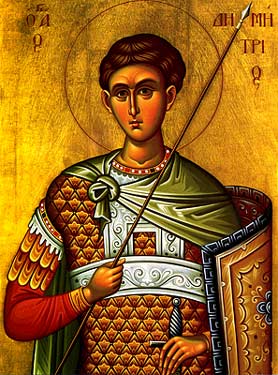
Saint Demetrios suffered in Thessalonika during the reign of Galerius Maximian (c. 306). He belonged to one of the most distinguished families of the province of Macedonia and was widely admired not only because of his noble ancestry and grace of bearing, but also for virtue, wisdom and goodness of heart surpassing that of his elders.
The military expertise of Saint Demetrios led Galerius, as Caesar of the Eastern Empire, to appoint him commander of the Roman forces in Thessaly and Proconsul for Hellas. But for all this, Demetrios remained ever aware of the underlying realities of life. Since faith in Christ had touched his heart, all the glory of this world meant nothing to him, and there was nothing he preferred to teaching and preaching the word of God.
Despite the persecution directed against Christians by the Emperor, Saint Demetrios brought a large number of pagans to the faith. His words convinced them because they saw in the righteousness, peace and brotherly love that marked his life an illustration of the truth of which he spoke.
The Emperor Maximian had just won a series of brilliant victories over the Scythians and was on his way back to Rome when he halted at Thessalonika to receive the acclamations of the populace and to offer sacrifices in thanksgiving to the idols.
A number of pagans, envious of the success of the Saint, took advantage of the Emperor’s presence in the city to denounce Demetrios as a Christian. Maximian’s astonishment gave way to violent indignation when he was told that Demetrios’ was making use of his official position to spread the faith. Demetrios was summoned and confined in a cell, located in the basement of nearby baths.
Maximian arranged for games and gladiatorial combats to take place in the amphitheater of the city. He had brought with him a man of gigantic stature and Herculean strength called Lyaios, a Vandal by origin. Such was this man’s strength and skill in single combat that no one could withstand him.
There was in the city a young Christian called Nestor, who observing the empty pride of the Emperor in the victories of his champion, made up his mind to show him that real power belongs to Christ alone. He ran to the baths where Demetrios was imprisoned and asked for the protection of his prayer in going to confront the giant. The Martyr made the sign of the Cross on the brow and the heart of the boy, and sent him like David before Goliath.
He reached the amphitheater just as the heralds were crying out on all sides for any who would stand against Lyaios. Advancing towards the Emperor, Nestor threw his tunic to the ground and shouted, “God of Demetrios, help me!” In the first encounter, at the very moment the giant rushed upon him, Nestor slipped aside and stabbed him to the heart with his dagger. There was uproar and amazement at the marvel, and people asked themselves how a mere child, relying neither on strength nor weapons, could so suddenly have brought down the barbarian.
Rather than yield to the sign of the sovereign power of God, the Emperor flew into a rage and ordered the immediate arrest of Nestor and his beheading outside the city. He had heard Nestor calling upon the God of Demetrios and, supposing the Saint had used some kind of witchcraft, Maximian ordered his soldiers to go and thrust Demetrios through with their lances, without trial, in the depths of his prison cell. There were some Christians, including Demetrios’ servant Lupus, present at his martyrdom, and when the soldiers had gone, they reverently buried the Saint’s body.
It was God’s will that the grace with which He filled Saint Demetrios should remain active even after his death. This is why He caused to flow from his body a myron with a delightful scent, which had the property of healing all who took it as an unction, with faith in the intercession of the Saint.
Time and again, during sixteen hundred years, Saint Demetrios has given proof of his benevolent care for the city of Thessalonika and its inhabitants. He has defended them from the attacks of barbarians, he has preserved them from plague and famine, healed the sick and comforted the afflicted.
September 2025

| Day | Date | Start | End | Details | Holy Communion? |
|---|---|---|---|---|---|
| Sunday | 7th | 9.15 | 12.45 | Sunday Service – Divine Liturgy | Yes |
| Sunday | 7th | 18.30 | 19.30 | Vespers – The Nativity of the All Holy Mother of God | No |
| Monday | 8th | 9.30 | 11.30 | The Nativity of the All Holy Mother of God | Yes |
| Saturday | 13th | 18.30 | 19.30 | Vespers – Exaltation of the Holy Cross | No |
| Sunday | 14th | 9.15 | 12.45 | Exaltation of the Holy Cross | Yes |
| Sunday | 21st | 9.15 | 12.45 | Sunday Service – Divine Liturgy | Yes |
| Sunday | 28th | 9.15 | 12.45 | Sunday Service – Divine Liturgy | Yes |
The Feast of the Nativity of Our Most Holy Lady, the Theotokos and Ever-Virgin Mary
The Feast of the Nativity of Our Most Holy Lady, the Theotokos and Ever-Virgin Mary is celebrated on September 8 each year. The Feast commemorates the birth of the Mother of Jesus Christ, our Lord.
Background
The birth and early life of the Virgin Mary is not recorded in the Gospels or other books of the New Testament, however this information can be found in a work dating from the second century known as the Book of James or Protevangelion.
According to the story found in this book, Mary’s parents, Joachim and Anna, were childless for many years. They remained faithful to God, but their prayers for a child were unanswered. One day, when Joachim came to the temple to make an offering, he was turned away by the High Priest who chastised him for his lack of children. To hide his shame, Joachim retreated to the hill country to live among the shepherds and their flocks.
As Joachim was praying, his wife Anna was praying at the same time at their house in Jerusalem. An angel appeared to both of them and announced that Anna would have a child whose name would be known throughout the world. Anna promised to offer her child as a gift to the Lord. Joachim returned home, and in due time Anna bore a daughter, Mary.
Icon of the Feast
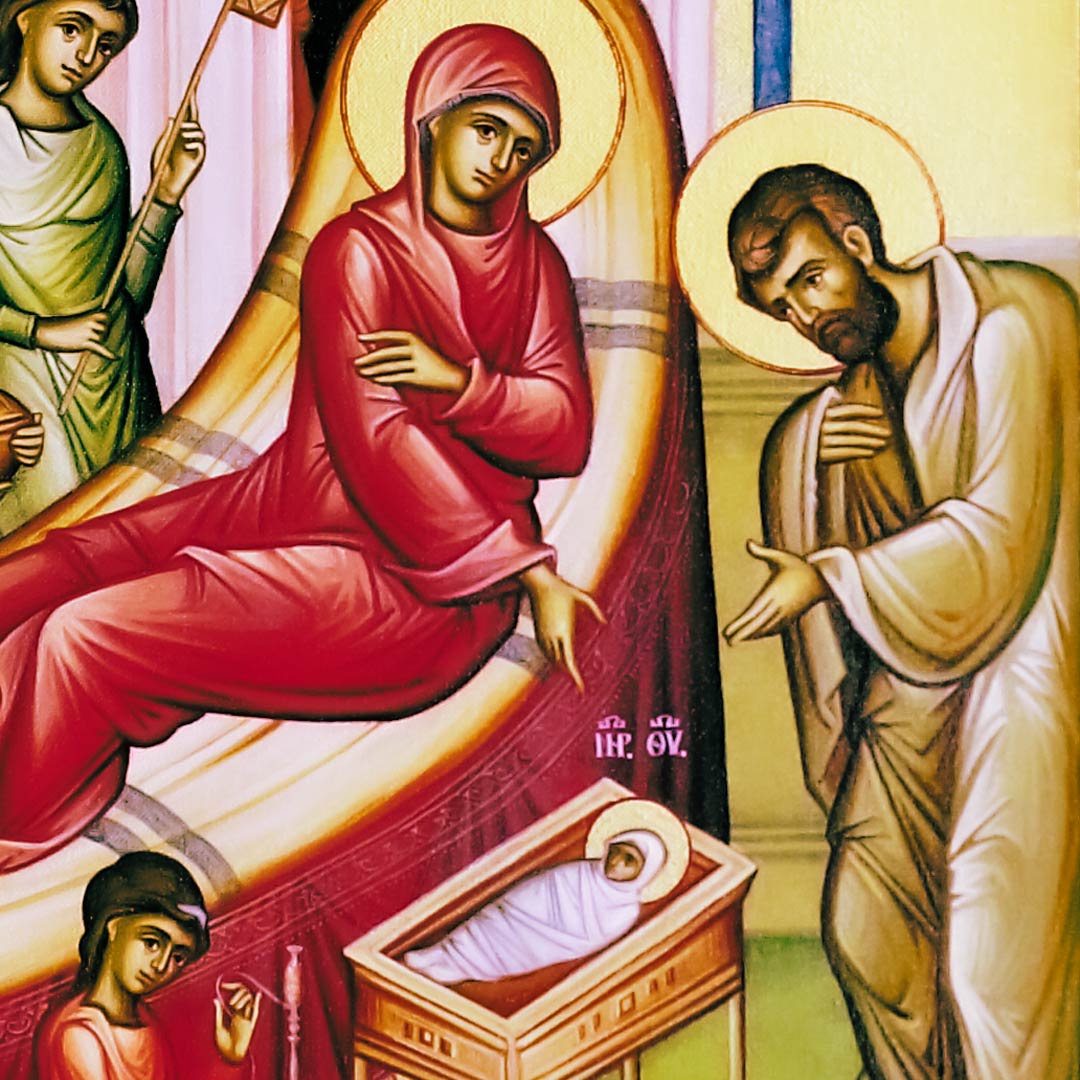
The icon directs attention to Mary as the central figure in this feast. It also acknowledges the joy that was felt by Joachim and Anna as new parents with a child received through a promise from God. The liturgical texts of the feast acknowledge this joy and confirm the special role of Mary as the Mother of the Incarnate God, Jesus Christ. In this event, another step is made in sacred history in preparation for the entrance of Christ into the world.
The icon and the feast also acknowledge a transition from barrenness to life. This was but another foreshadowing of what would be offered through Christ, the transformation from death to eternal life.
Orthodox Christian Celebration of the Feast of the Nativity of the Theotokos
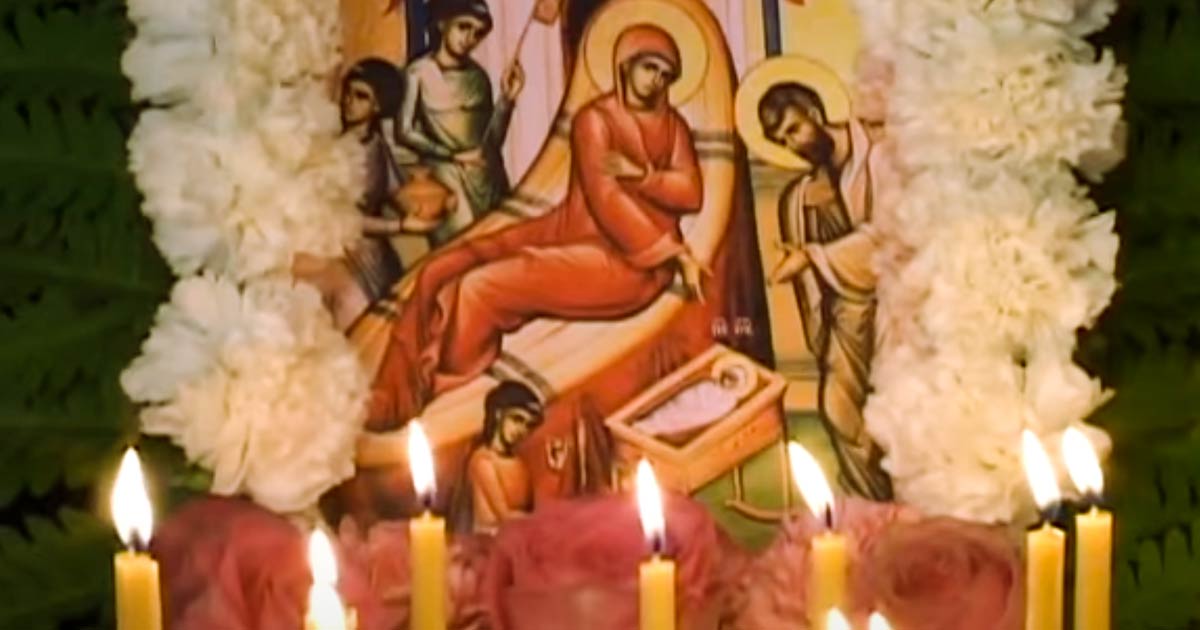
The Feast of the Nativity of the Theotokos is celebrated with the Divine Liturgy of Saint John Chrysostom which is conducted on the morning of the Feast and preceded by a Matins (Orthros) service. A Great Vespers is conducted on the evening before the day of the Feast. Scripture readings for the Feast are the following: At Vespers: Genesis 28:10-17; Ezekiel 43:27—44:4; Proverbs 9:1-11. At the Matins: Luke 1:39-49, 56. At the Divine Liturgy: Philippians 2:5-11; Luke 10:38-42; 11:27-28.
The Exaltation of the Holy Cross
The Feast of the Universal Exaltation of the Precious and Life-Giving Cross is celebrated each year on September 14. The Feast commemorates the finding of the True Cross of our Lord and Saviour Jesus Christ by Saint Helen, the mother of the Emperor Constantine.
Background
In the twentieth year of his reign (326), the Emperor Constantine sent his mother Saint Helen to Jerusalem to venerate the holy places and to find the site of the Holy Sepulchre and of the Cross. Relying upon the oral tradition of the faithful, Saint Helen found the precious Cross together with the crosses of the two thieves crucified with our Lord. However, Helen had no way of determining which was the Cross of Christ.
With the healing of a dying woman who touched one of the crosses, Patriarch Macarius of Jerusalem identified the True Cross of Christ. Saint Helen and her court venerated the Precious and Life-Giving Cross along with many others who came to see this great instrument of Redemption.
The Patriarch mounted the ambo (pulpit) and lifted the Cross with both hands so that all of the people gathered could see it. The crowd responded with “Lord have mercy”.
This became the occasion of the institution in all of the Churches of the Exaltation of the Precious Cross, not only in memory of the event of the finding of the Cross, but also to celebrate how an instrument of shame was used to overcome death and bring salvation and eternal life.
The Feast is an opportunity outside of the observances of Holy Week to celebrate the full significance of the victory of the Cross over the powers of the world, and the triumph of the wisdom of God through the Cross over the wisdom of this world. This Feast also gives the Church an opportunity to relish the full glory of the Cross as a source of light, hope and victory for Christ’s people. It is also a time to celebrate the universality of the work of redemption accomplished through the Cross: the entire universe is seen through the light of the Cross, the new Tree of Life which provides nourishment for those who have been redeemed in Christ.
Icon of the Feast
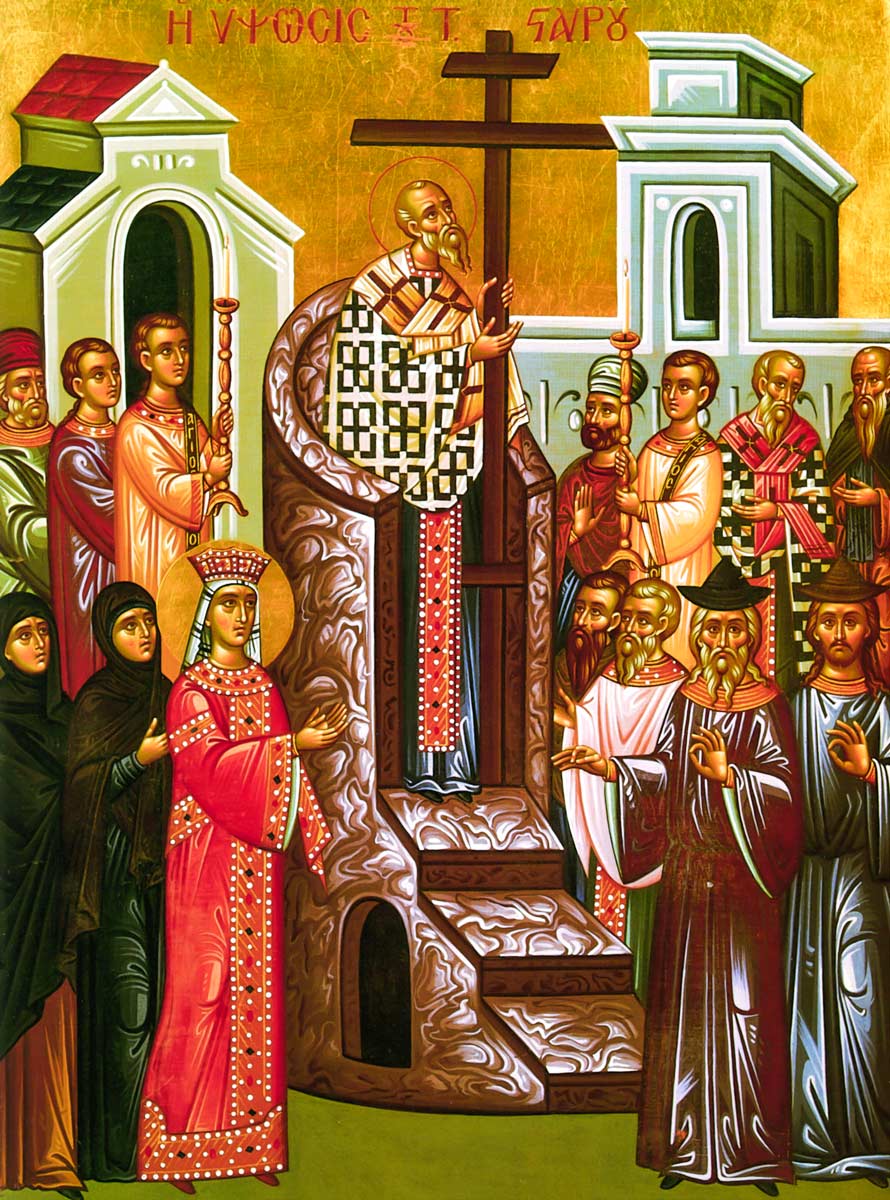
The icon of the Feast of the Precious Cross tells the story of the finding of the Cross and of its Exaltation. Patriarch Macarius is standing in the pulpit elevating the Cross for all to see and venerate. On each side of the Patriarch are deacons holding candles. The elevated Cross is surrounded and venerated by many clergy and lay people, including Saint Helen, the mother of Emperor Constantine.
In the background of the icon is a domed structure that represents the Church of the Resurrection in Jerusalem. This church was one of the churches constructed and dedicated by Emperor Constantine on the holy sites of Jerusalem.
August 2025

| Day | Date | Start | End | Details | Holy Communion? | Saints Days Celebrated | Scripture Readings |
|---|---|---|---|---|---|---|---|
| Friday | 1st | 7pm | 8pm | Paraklisis/Petition to Virgin Mary | No | N/A | |
| Sunday | 3rd | 9.15 | 12.45 | 8th Sunday of Matthew | Yes | Isaacius, Dalmatus, & Faustus, Ascetics of the Dalmation | John 20.11-18 (8th Matins Gospel), 1 Corinthians 1.10-18 (Epistle), Matthew 14.14-22 (Gospel) |
| Monday | 4th | 7pm | 8pm | Paraklisis/Petition to Virgin Mary | No | N/A | |
| Tuesday | 5th | 6pm | 7pm | Vespers of Transfiguration | No | N/A | |
| Wednesday | 6th | 9.15 | 11.00 | Transfiguration of Christ | Yes | N/A | Luke 9:28-36, II Peter 1:10-19, Matthew 17:1-9 |
| Wednesday | 6th | 11.00 | 12.30 | Vespers of Transfiguration | No | N/A | |
| Thursday | 7th | 7pm | 8pm | Vespers of Transfiguration | No | N/A | |
| Friday | 8th | 7pm | 8pm | Vespers of Transfiguration | No | N/A | |
| Sunday | 10th | 9.15 | 12.45 | 9th Sunday of Matthew | Yes | Xystus, Hippolytus, Lawrence the Archdeacon | John 20:19-31, I Corinthians 3:9-17 |
| Monday | 11th | 7pm | 8pm | Vespers of Transfiguration | No | N/A | |
| Tuesday | 12th | 7pm | 8pm | Vespers of Transfiguration | No | N/A | Matthew 14:22-34 |
| Wednesday | 13th | 7pm | 8pm | Vespers of Transfiguration | No | N/A | |
| Thursday | 14th | 7pm | 8pm | Vespers Dormition of Theotokos | No | N/A | |
| Friday | 15th | 9.15 | 12 noon | Dormition of Theotokos | Yes | N/A | Luke 1:39-49, 56, Philippians 2:5-11, Luke 10:38-42, 11:27-28 |
| Sunday | 17th | 9.15 | 12.45 | 10th Sunday of Matthew | Yes | Myron, Thyrsus, Leucius | John 21:1-14, I Corinthians 4:9-16, Matthew 17:14-23 |
| Sunday | 24th | 9.15 | 12.45 | 11th Sunday of Matthew | Yes | Cosmas of Aetolia, Dionysius of Aegea | John 21:14-25, I Corinthians 9:2-12, Matthew 18:23-35 |
| Sunday | 31st | 9.15 | 12.45 | 12th Sunday of Matthew | Yes | Fanourios (Fanouropita) | Matthew 28:16-20, Hebrews 9:1-7, Matthew 19:16-26 |
Agios Fanourios

On August 27 the Greek Orthodox Church celebrates the Feast Day of Agios Fanourios, commemorating the Martyr and Miracle Worker who is asked to intercede when things are lost.
Fanouropita is also made on August 27th, to commemorate Saint Fanourios.
The story behind this is said to be that the Saint’s mother is said to have been a tough, and hard woman especially towards the poor, and behaved inhumanly and The Archangel Michael, along with Agios Fanourios, tried to help her change but couldn’t.
Agios Fanourios begged and prayed not for himself but for his mother to be forgiven and for her soul to rest in peace and this is said to have been heard by God. So now the faithful also turn to Agios Fanourios to intercede for them and to pray for them when they lose objects and ask for him to reveal them or to bring them something they desire, especially good health, fertility, or even a for a husband and wife for those who are single.
Churches Dedicated to Agios Fanourios
The best known church is located at the namesake street in the Medieval Town of Rhodes. It was built in the 13th century A.D. It’s cross shaped and the interior is adorned with wonderful frescos. It officiated as a mesgit (small mosque) during the ottoman occupation.


There is no known testimony for its name before the ottoman period. The interior was preserved in the 20’s by the Italian Archaeological Service and after WWII, Greeks took over the church. In 1946 the church was inaugurated and dedicated to Agios Fanourios.
The worship of Agios Fanourios seems to have started from Rhodes and then expanded initially to Crete and then to the rest of the country.
Different sources cite that, while workers were digging outside the southern walls to collect building materials, they uncovered the ruins of a church. Among other things, an icon was found depicting Agios Fanourios wearing a military uniform and surrounded by scenes of his martyrdom.
Obviously that icon was part of a fresco. Agios Fanourios’ first miracle was the liberation of three Cretan priests from pirates while transferring a copy of the archetypal icon to Crete.
There is a special church dedicated to Agios Fanourios, which is located at Lake Doxa, which is an artificial lake in western Corinthia, Greece. It is situated at an elevation of 900m, in the municipal unit Feneos, near the village Archaia Feneos.
Construction was completed in the late 1990s. It is fed and drained by the small river Doxa, which empties into the plain of Feneos. In the heart of the lake on a small peninsula features the small church of Agios Fanourios.

There is also a church dedicated to Saint Fanourios at Drapetzona in Piraeus.


The Tortures of Agios Fanourios
Saint Fanourios, who lived during Roman times, went up bravely against the idolatric world, for the Christian spirit of this man of God did not allow him to deny his unquestionably virtuous principles.
Thus, the 12 tortures that the Saint suffered constitute for us a strong motivation for perseverance and adherence to the moral values of Christianity, to come out victors from the in-cessant struggle of unbelief and injustice of our time.
This Saint teaches us with his real sacrifice that even though we do not struggle against Roman soldiers and vile Hagarenes, still we have to confront the more skillfully set traps of materialism and atheism, that attempt en masse to overwhelm the Christian order.
Saint Fanourios also taught us that the crown of a virtuous life is not easily won but only through continuous tests – with boldness, patience and perseverance. Therefore, as true fighters of the faith let us imitate the exemplary and irreproachable life of the Saint, so that we too may be found worthy to honour the Christian name we bear, as he so fittingly did.
The icon of Fanourios often depicts the 12 tortures/tribulations that he was subjected to as the pagan Roman rulers tried to force him to denounce his Christian beliefs. Below is what the icon typically shows.

1. The Saint is present in front of the Roman magistrate, standing and looking like he is boldly testifying and defending his Christian faith.
2. Here the soldiers are intervening and striking Fanourios’ head and the mouth with stones to force him to succumb and deny the Lord.
3. The soldiers have thus far become enraged by the persistence of Fanourios, throwing him to the ground and beating him mercilessly with sticks and clubs to break his steadfast resistance.
4. Fanourios is in jail and is being tortured in a most abominable way. He appears totally naked and the surrounding soldiers are tearing his flesh with sharp metal instruments. The Saint is silently enduring his frightful martyrdom.
5. Fanourios is back in jail praying to God to strengthen him to the end of his tortures.
6. The Saint is again brought before the Roman magistrate to give a defense for his posi-tion. By the peaceful expression on his face it appears that neither the tortures he suf-fered nor the future threats of the tyrant can shake his faith, and thus being undeterred he is waiting for further tortures.
7. The torturers of Fanourios with rage and cruelty are burning his naked body with lit torches, thus showing his insuperable sacrifice for the Crucified One. The Saint wins again with his indomitable will and fortitude for the Lord.
8. Here his savage torturers are making use of mechanical means to achieve the worse of his tortures. They have tied the Saint on a press which crushes his bones when rotated. He is suffering without grumbling, but on his beautiful face there is an inexpressible exul-tation since he is suffering for the sake of the Lord.
9. Fanourios is cast into a pit to become prey to wild beasts and his torturers are watching from above to witness his end. The beasts, however, are totally docile through the grace of God and silently surround him like lambs to enjoy his magnificent company.
10. The torturers were not satisfied by the latest result so they removed him from the hole and are crushing him under a huge rock, convinced that they will finish him off. However, even this time they do not succeed.
11. The scene presents the Saint in front of an altar, where the torturers are urging him to sacrifice, placing burning coal in his hands. Fanourios also passes this test victoriously and a devil in the form of a dragon is shown flying in the air and crying over its failure.
12. The last scene is the end of his martyrdom, with Fanourios being cast into a large furnace standing on a stool and surrounded by flames and smoke. The Saint seems to be praying intently to God, without complaining or grumbling, and thus unwavering and without giving in, he flew to heaven, full of contentment for all the tortures he had suffered for the sake of the Lord.
This is why Agios Fanourios is known as ‘The Undefeated One’.
The Saint For Finding Lost Things
Agios Fanourios’ name is from the Greek word ‘fanerono’ which means reveal.
The tradition of baking a Fanouropita is a great honour bestowed upon the Saint.
Many Greeks worldwide today will make a Fanouropita and take it to church to be blessed and then they will share it amongst family and friends.
When you make the cake, you are also meant to say-
“Lord have mercy on the soul of Agios Fanourios’ mother.”
Today is also the name day of Fanourios, Fanouria.
Xronia Polla!
Agios Fanourios’ name is from the Greek word ‘fanerono’ which means reveal.
The tradition of baking a Fanouropita is a great honour bestowed upon the Saint.
Many Greeks worldwide today will make a Fanouropita and take it to church to be blessed and then they will share it amongst family and friends.
When you make the cake, you are also meant to say-
“Lord have mercy on the soul of Agios Fanourios’ mother.”
Today is also the name day of Fanourios, Fanouria.
Xronia Polla!
Here is an easy to follow recipe-

Ingredients →
- 1 x cup olive oil
- 1 ¼ cups fresh orange juice
- 2 x teaspoons ground cinnamon
- 1/2 x teaspoon ground cloves
- 1 x cup sugar
- 2 x cups self-raising flour, sifted
- 1 x cup walnuts, chopped
- 1 x teaspoon baking powder
- Icing sugar for garnishing (optional)
Method →
- Preheat the oven to 160°C and line a 20–25 cm round cake tin with baking paper.
- Place the olive oil, orange juice, cinnamon, cloves and sugar in a bowl and mix well with a wooden spoon until the sugar dissolves a little.
- Gradually add the flour, mixing well, then add the walnuts, followed by the baking powder. Stir until well combined.
- Pour the cake mix into the tin and bake for 15 minutes.
- Reduce the temperature to 130°C and bake for a further 40 minutes or until cooked (a skewer inserted into the centre should come out clean). Transfer to a wire rack to cool slightly.
- Dust with icing sugar and serve warm or at room temperature.